Brighton & Hove City Council Propaganda
In December 2024, the council launched its "Wood burners and open fires – The Cosy Killer" campaign. The campaign aimed to persuade residents to reduce or stop burning solid fuels, particularly in urban areas, by highlighting the health impacts of fine particulate pollution (PM2.5). It's advertising claims that burning wood contributes significantly to harmful air pollution.
They have monitored
PM2.5 particulate pollution, Nitrogen dioxide (NO₂), Nitric oxide (NO), Ozone and Weather conditions and have concluded that winter PM2.5 levels rise substantially during the winter season which is not surprising as when it's colder is when people burn fuel to keep warm.
They included this statement in their advertising campaign but have had to cease the campaign due to complaints.
They included this statement in their advertising campaign but have had to cease the campaign due to complaints.
The Advertising Standards Authority
accepts that the council has evidence showing higher PM2.5 levels during the winter monitoring period.
However, it also concluded that the advertisement misleadingly implied that wood burners and open fires were the direct cause of the increase, and that the council had not provided sufficiently robust evidence to substantiate that claim. The ASA required the advertisement not to appear again in its original form.
accepts that the council has evidence showing higher PM2.5 levels during the winter monitoring period.
However, it also concluded that the advertisement misleadingly implied that wood burners and open fires were the direct cause of the increase, and that the council had not provided sufficiently robust evidence to substantiate that claim. The ASA required the advertisement not to appear again in its original form.
In May 2026
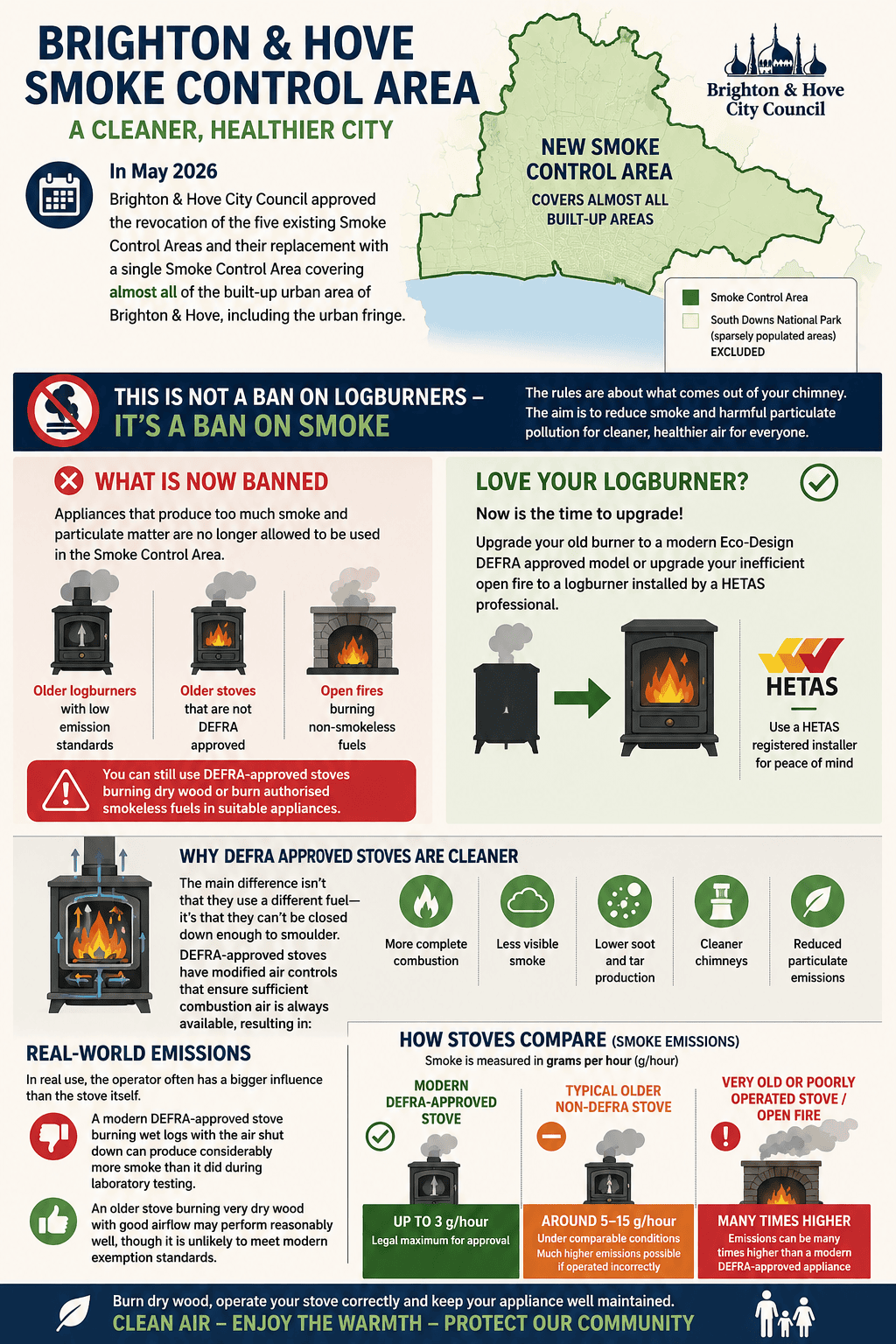
Brighton & Hove City Council approved the revocation of the five existing Smoke Control Areas and their replacement with a single Smoke Control Area covering almost all of the built-up urban area of Brighton & Hove, including the urban fringe.
Brighton & Hove City Council approved the revocation of the five existing Smoke Control Areas and their replacement with a single Smoke Control Area covering almost all of the built-up urban area of Brighton & Hove, including the urban fringe.
It's a ban on smoke NOT log burners
People using older logburners with low emission standards, older not DEFRA approved stoves or open fires burning non-smokeless fuels produce to much smoke and particulate matter so these are what are now banned from being used.
If you love your logburner then now is the time to upgrade your old burner to a modern eco-design model or upgrade your inefficient open fire to a logburner installed by a HETAS professional.
If you love your logburner then now is the time to upgrade your old burner to a modern eco-design model or upgrade your inefficient open fire to a logburner installed by a HETAS professional.
Why DEFRA approved stoves are cleaner
The main difference isn't that they use a different fuel—it's that they can't be closed down enough to smoulder or slumber
DEFRA-approved stoves have modified air controls that ensure sufficient combustion air is always available, resulting in:
- more complete combustion,
- less visible smoke,
- lower soot and tar production,
- cleaner chimneys, and
- reduced particulate emissions.
Real-world emissions
In real use, the operator often has a bigger influence than the stove itself. A modern DEFRA-approved stove burning wet logs with the air shut down can produce considerably more smoke than it did during laboratory testing. Conversely, an older stove burning very dry wood with good airflow may perform reasonably well, though it is unlikely to meet modern exemption standards.
So, if you're comparing appliances, it's reasonable to say:
- Modern DEFRA-approved stove:up to 3 g/hour of smoke (legal maximum for approval).
- Typical older non-DEFRA stove:around 5–15 g/hour under comparable conditions, with much higher emissions possible if operated incorrectly.
- Very old or poorly operated stove/open fire: emissions can be many times higher than a modern DEFRA-approved appliance.